Gaming moves fast, sometimes too fast. Yesterday’s mind-blowing feature is today’s table stakes. For players and enthusiasts, the hard part isn’t chasing every announcement; it’s figuring out what’ll actually stick around. This guide focuses on the shifts that count, with solid analysis of game design, performance tech, and new systems that’re reshaping the industry. AI-driven worlds. Physics engines that break old limits. We dig into the most credible predictions about gaming’s future, which technologies’ll actually change how we play, compete, and experience games over the next decade, and which ones won’t make it past the hype cycle.
The AI revolution: from smarter npcs to infinite worlds
The AI revolution isn’t just a tech upgrade, it’s a player upgrade. What’s in it for you? Deeper immersion. Smarter systems. Games that feel built around your unique playstyle. These aren’t abstract promises. You’ll notice it immediately: NPCs that react to your decisions, difficulty that adjusts on the fly, and narratives that actually remember what you did last chapter.
Generative AI NPCs
Forget rigid dialogue trees. Soon, NPCs will carry dynamic memories, remembering your betrayals, alliances, and even small talk. That means no two playthroughs feel the same. Instead of scripted responses, characters evolve alongside you. The benefit? Stories that feel personal, like your own branching Netflix series (but you control the plot).
Procedural Content Generation 2.0
Bigger maps were impressive. Meaningful worlds? That’s something else entirely. AI will generate ecosystems with internal logic, wildlife that actually interacts, factions with believable histories, quests rooted in regional politics. You’re exploring a world that rewards curiosity—not just clearing another map. Less random loot cave. More living, breathing continent.
AI as a Co-Developer
Smaller studios are already using AI-powered tools to punch way above their weight, churning out AAA-quality animations, textures, and environments that used to require massive budgets most indie teams simply couldn’t touch. For players? It changes everything. We’re talking about a flood of ambitious indie titles that can compete visually and mechanically with blockbuster releases, which means more voices, more bets on weird ideas, and more pressure on established studios to innovate instead of iterate. Competition works that way. Better games follow.
| AI Innovation | Player Benefit |
|---|---|
| Dynamic NPC Memory | Personalized story arcs |
| Smart World Generation | Cohesive exploration |
| AI Asset Creation | Higher-quality indie games |
| Real-Time Scaling | Balanced challenge |
Real-Time Difficulty Scaling
AI’ll monitor performance and subtly tune encounters to keep you in flow state, that sweet spot where you’re fully immersed and just challenged enough. Rage quits? Gone. Boredom? Also gone.
Among gaming’s many predicted futures, this one matters most: games won’t just react to you, they’ll actually understand what you’re doing. And that changes everything. When a game gets you, every session stops feeling like you’re running through the same pre-built maze. It feels made for you, right now, in a way that’s never happened before.
The engine room: data-driven physics and unseen forces
The next leap in game engines isn’t shinier reflections—it’s believable physics. Think beyond ragdoll animations (funny the first time, immersion-breaking the tenth). Developers are building systems where weight, friction, torque, and material stress are calculated in real time. Physical authenticity will define immersion more than polygon count.
Practical example: skip the scripted collapse. Simulate actual structural load instead. When too many players pile onto one side, it buckles on its own, without requiring any coded failure state. Build it like this: track the cumulative weight on each side, apply a physics-based stress calculation, and trigger the structural failure only when the load genuinely exceeds what the model can support. It’s simpler than choreographing a collapse frame-by-frame, and it feels real to players because it is.
- Assign material properties (density, tensile strength).
- Enable real-time force calculations.
- Stress-test with edge-case scenarios (speedrunners will find them).
The concept of “magnetic” mechanics
Imagine gameplay built around invisible forces, magnetism, gravity wells, acoustic pressure. A puzzle asks you to reverse polarity and walk straight through a wall, or curve a projectile mid-air just by thinking it. Very sci-fi. Very satisfying. The best part? You feel like a physicist, not a button-masher. You’re manipulating the rules of space itself, which sounds abstract until you’re standing in front of an unsolvable barrier and realize: oh, I can flip the charge. The puzzle snaps open. That moment. That’s where this kind of design lives, and it doesn’t require flashy effects or cutscenes to land, just a rule waiting to be broken.
Pro tip: Start small. Prototype one force system and build mechanics around it before layering others.
Cloud-native processing
Offloading heavy physics and AI to cloud servers lets even modest hardware render massive destruction and thousand-unit battles. Your console won’t melt. Remote servers crunch the calculations and stream results back in milliseconds.
| Feature | Local Processing | Cloud-Native Processing |
|---|---|---|
| Destruction Scale | Limited |
Massive, persistent |
| AI Complexity | Moderate | High-density behaviors |
| Hardware Demand | High | Reduced on device |
Data-driven environments
Game worlds’ll evolve based on what players actually do. Overmine a region? Resources disappear for good. Defend a city together? It flourishes. That’s not speculation, it’s how the next generation of games will work. These aren’t predictions. They’re blueprints.
Action step: Track player data trends and feed them into dynamic world variables. Let behavior rewrite terrain, economy, even faction power.
Because when engines simulate unseen forces, and remember our choices, games stop feeling programmed and start feeling alive.
Hardware and haptics: how we’ll see, hear, and feel games

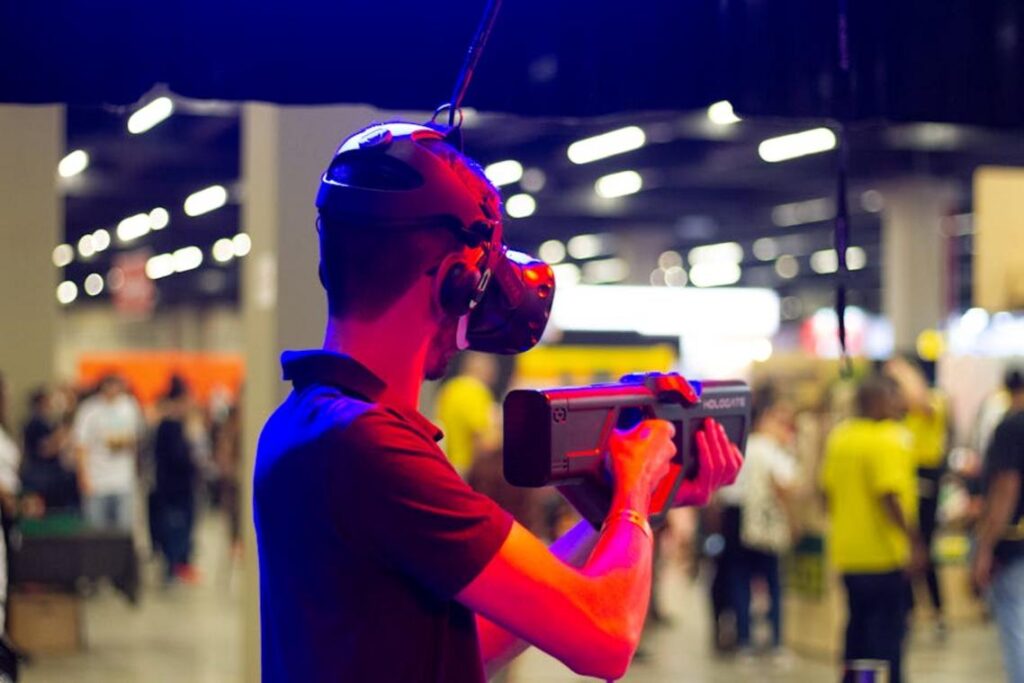
Mixed reality merges physical and digital worlds so virtual objects interact with your real environment instantly. Imagine ditching today’s bulky headsets for AR glasses you’d actually want to wear, not some sci-fi visor that screams “I’m a tech nerd.” A hardware engineer put it bluntly: “If it still feels like a helmet, we’ve failed.” The bar’s clear. Seamless immersion. Digital dragons on your coffee table. Whether they behave is another question entirely.
Skeptics say AR glasses will stay too pricey and socially awkward. Fair point. Early smartphones were clunky, bulky things that nobody wanted to pull out in public. But adoption doesn’t track perfection, it tracks whether people actually find something comfortable and useful enough to carry anyway. AirPods proved that.
Next comes advanced haptics. Haptic feedback refers to technology that simulates touch sensations. We’re moving beyond simple controller rumbles toward gloves and suits that recreate tension, texture, even temperature. “When you draw a bowstring, you should feel resistance,” one developer noted. That tactile realism changes competitive play.
Then there are BCIs, brain-computer interfaces that translate neural signals into commands. They started as accessibility tools. Sure, privacy concerns are real, and they deserve serious attention. But most innovations begin small, in niche markets, before they expand. That’s the pattern here too.
Future of gaming predictions in the section once exactly as it is given
For deeper production insights, revisit lessons from veteran developers on sustainable production.
Evolving playstyles: the future of esports and community
AI-driven coaching is reshaping the pro-player pipeline. Software now analyzes gameplay frame by frame, pulling out personalized drills and strategy recommendations, Moneyball for headshots, basically. Sure, critics aren’t wrong: AI can’t replicate human intuition or the weight of a veteran coach’s experience. It won’t. But here’s what it does do. It surfaces blind spots even pros overlook, the kind of micro-inefficiencies that talent alone misses. Data-informed training measurably improves performance outcomes (Harvard Business Review, 2020 found this across multiple esports disciplines). The gap between gut feel and granular insight? It’s widening fast.
Meanwhile, the Creator-Centric Game will blur the line between player and developer, some argue too much modding splinters communities. But Roblox and similar platforms show that user-generated ecosystems actually drive engagement and revenue (Roblox Investor Report, 2023). The data backs it up.
Here’s one of many future of gaming predictions:
- INNOVATION
- Community monetization
- Adaptive competition
Your next save point
You came here to understand where gaming is headed. Now you’ve seen what’s actually driving it: intelligent AI. Advanced physics. Immersive hardware. Player-powered ecosystems. The future of gaming predictions aren’t just about prettier worlds, they’re about deeper agency, richer immersion, and experiences that actually respond to you.
If you’re not keeping up, you’ll fall behind. These mechanics are becoming standard. Stay ahead. Follow the trends. Test emerging tech. Sharpen your edge with insights trusted by thousands of competitive and tech-savvy players. Don’t just play the future, prepare for it now.
 Creative Director
There is a specific skill involved in explaining something clearly — one that is completely separate from actually knowing the subject. Lorraines Pricevadan has both. They has spent years working with expert insights in a hands-on capacity, and an equal amount of time figuring out how to translate that experience into writing that people with different backgrounds can actually absorb and use.
Lorraines tends to approach complex subjects — Expert Insights, Core Mechanics and Playstyles, Tech-Driven Gaming Gear Tips being good examples — by starting with what the reader already knows, then building outward from there rather than dropping them in the deep end. It sounds like a small thing. In practice it makes a significant difference in whether someone finishes the article or abandons it halfway through. They is also good at knowing when to stop — a surprisingly underrated skill. Some writers bury useful information under so many caveats and qualifications that the point disappears. Lorraines knows where the point is and gets there without too many detours.
The practical effect of all this is that people who read Lorraines's work tend to come away actually capable of doing something with it. Not just vaguely informed — actually capable. For a writer working in expert insights, that is probably the best possible outcome, and it's the standard Lorraines holds they's own work to.
Creative Director
There is a specific skill involved in explaining something clearly — one that is completely separate from actually knowing the subject. Lorraines Pricevadan has both. They has spent years working with expert insights in a hands-on capacity, and an equal amount of time figuring out how to translate that experience into writing that people with different backgrounds can actually absorb and use.
Lorraines tends to approach complex subjects — Expert Insights, Core Mechanics and Playstyles, Tech-Driven Gaming Gear Tips being good examples — by starting with what the reader already knows, then building outward from there rather than dropping them in the deep end. It sounds like a small thing. In practice it makes a significant difference in whether someone finishes the article or abandons it halfway through. They is also good at knowing when to stop — a surprisingly underrated skill. Some writers bury useful information under so many caveats and qualifications that the point disappears. Lorraines knows where the point is and gets there without too many detours.
The practical effect of all this is that people who read Lorraines's work tend to come away actually capable of doing something with it. Not just vaguely informed — actually capable. For a writer working in expert insights, that is probably the best possible outcome, and it's the standard Lorraines holds they's own work to.