

Gaming moves fast. New mechanics emerge overnight. Esports metas shift in weeks, and tech-driven gear can change how you play before you’ve mastered your current setup. You’re probably here because you want the real story, what actually shapes modern games. The core mechanics. The playstyles that keep shifting. Competitive scenes. The engines running it all. We’re digging into exactly that.
This article cuts through the noise. It explores how innovative systems design shapes competitive play, what happens to the meta when it shifts, and why mag-based engine developments matter for raw gameplay performance. Data analytics is reshaping matchmaking, in-game economies, and the spaces between them. Studios now have real tools to understand what actually makes a game feel good to play, not just sound good on paper.
We built this on real testing, digging into how things actually work, and staying on top of what competitors and new tech are doing. It’s simple. Give you insights that actually stick, that you can use right now, whether you’re racing, building something, or tweaking your system to run better. No fluff.
Great games aren’t balanced by vibes alone. You’ve got to tune them with data, which means instrumenting your build with event tracking. Log specific player actions: jumps, deaths, purchases. Measure retention, churn, progression drop-offs. Cohort analysis groups players by shared traits and shows you how updates shift their behavior. Level-three exits spike after a difficulty tweak? That’s friction, not challenge. Some devs swear intuition is faster. It’s not, not really. Dashboards reveal what you can’t see coming. Run A/B tests before launch to validate changes, then iterate hard. The teams that win don’t replace creativity with evidence. They let evidence guide it.
The developer’s toolkit: key data types and collection methods
Player telemetry: the goldmine
Start with player telemetry. Raw, automated data on what players actually do, position, actions per minute, ability usage, session length. It’s a live feed of behavior, not opinions, and for mechanics balancing you need it. A weapon with a 78% win-rate across 10,000 matches isn’t a feeling. It’s a problem (Riot Games has talked about these same metrics). Here’s what matters, though: track the outliers. Edge cases matter way more than averages, because that’s where the real damage lives. Exploits hide in those gaps.
A/b testing for features
Next, implement A/B testing, comparing two feature variations with different player segments. Test two tutorial layouts, measure completion rate. If Version B improves completion by 15%, ship it. Sure, some say this stifles creativity. But structured experiments actually protect bold ideas. You get evidence. In data analytics for game design, controlled testing cuts through the guesswork. Google’s experimentation reports back this up.
Sentiment analysis: beyond the numbers
Numbers don’t tell you everything. Sentiment analysis uses natural language processing to pull emotional signals from reviews, forums, and social posts, and when telemetry shows engagement holding steady but sentiment’s tanking? That’s your red flag. Something’s wrong. Friction’s building beneath the surface, invisible to the metrics everyone watches. No Man’s Sky at launch proved it.
Setting up your data pipeline
Finally, instrument event-based tracking from day one. Capture meaningful interactions—level starts, item crafts, rage quits. I recommend reviewing your core loops alongside your core mechanics map before launch. Clean pipelines prevent messy retrospectives later (and future you will be grateful).
Core analysis techniques in action: from heatmaps to funnels
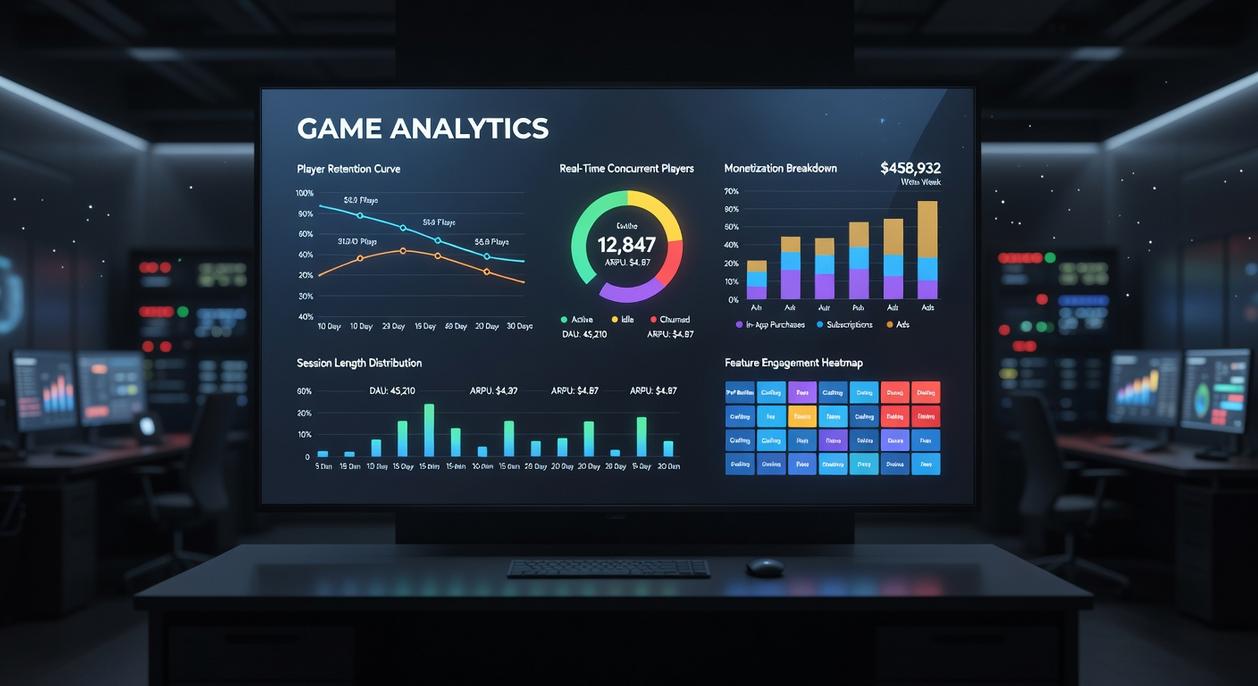
Great design feels intuitive. But intuition doesn’t scale, does it? That’s where data analytics comes in. It takes raw player behavior and turns it into insights you can actually use to improve the game. Instead of guessing what players want, you’re watching what they actually do, then building on that.
Heatmaps for level and encounter design
Heatmaps show where players cluster and die, think red for hotspots, blue for the quiet zones. When 65% of deaths pile up around a single choke point? That’s not a sign players need to “get good.” It’s a design problem. Call of Duty developers have leaned on heatmaps for years to rebalance spawns and kill off spawn trapping, that dominant camping tactic that shuts down half the match.
Large blue zones can actually signal wasted level space. When only 12% of players ever enter a side corridor, it probably needs stronger rewards or clearer visual guidance. Here’s the thing: compare death heatmaps with time-spent heatmaps. Death clusters don’t always mean the area’s broken. Time spent tells you something different. You’re separating genuine challenge from pure frustration.
Funnel analysis for onboarding and progression
A Funnel tracks how players move through sequential milestones. Say 100% start the tutorial, 78% complete it, 52% defeat the first boss, 31% unlock crafting. That drop from 78% to 52%? It’s not random. It’s friction.
GameAnalytics research shows onboarding drop-offs happen fast. Usually within the first 10 minutes when mechanics feel fuzzy, players are gone. Pair your funnel data with session recordings or surveys, you’ll uncover what’s actually killing retention, and it’s almost never difficulty. Poor feedback. That’s the real culprit. Most teams blame the learning curve when the real problem is players don’t know what they’re supposed to do next.
Economy balancing with source/sink analysis
In virtual economies, sources generate currency, quests drop gold, loot sells for cash, while sinks remove it through upgrades and crafting fees. When daily generation outpaces spending by 20% or more, inflation kicks in. Prices become meaningless. It’s a real problem. World of Warcraft’s been doing this for years, constantly adding new gold sinks to keep markets from collapsing, because without them the whole system falls apart.
Balance ensures progression feels rewarding without trivializing effort.
Win/loss and pick rate for character/weapon balancing
High pick rate plus high win rate screams overpowered. Low pick rate with low win rate? That’s underpowered. Riot Games has openly said they use these metrics to shape their balance patches, and it’s become the foundation of how they think about the game.
Still, some argue raw statistics ignore skill ceilings. True, but combining pick/win rates with rank segmentation resolves that blind spot.
For a broader view of where competitive systems are heading, see expert predictions next decade of gaming.
Practical application: tuning a “mag-engine” mechanic
When playtesters say a mechanic feels “off,” that’s a symptom. The cause lives in the numbers.
In this mag-engine scenario, early sessions showed a 72% preference for Push over pull across 500 recorded encounters. That’s not a vibe, that’s a pattern. Pull showed up in just 18% of combat situations and came with 34% longer puzzle completion times. Push? It cut average time-to-kill by 41%. The imbalance was obvious.
Some designers argue that player preference alone justifies imbalance, if it’s fun, ship it. But popularity doesn’t equal health. Overpowered tools shrink strategy space, the range of viable player choices in a system. Everyone picks the same character in a fighting game, and depth just vanishes.
Using data analytics in game design, the team ran A/B tests on three variables:
- Magnetic force magnitude
- Effective pull range
- Energy cost per activation
Version B pushed the pull range up 25%, which drove usage to 46% and shaved 19% off puzzle completion times. The 30% bump to push energy costs? It worked. Combat pacing stayed balanced without tanking satisfaction scores, which held at 8.1/10.
Small numerical tweaks radically shift behavior. That’s the core finding. Track ability usage per encounter, not per session, and you’ll spot imbalance fast. What started as frustrating friction became something flexible, something players actually wanted, backed by concrete data that proved it worked.
Game analytics platforms like Unity Analytics and GameAnalytics let you track what actually matters: retention, ARPDAU (average revenue per daily active user), and churn. You’ll find these metrics right there in pre-built dashboards. Here’s what to do: connect your game client SDK, define your events, level Complete, item Purchase, and check those cohort reports weekly. That’s step one. Most teams get stuck trying to measure everything at once, but you don’t need to. Start small, move fast.
Next, layer in BI tools like Tableau or Power BI. Export your data, build funnels, and visualize where people drop off. You can compare tutorial completion rates across different device types, iOS users might abandon faster than desktop users, for instance. This kind of breakdown reveals friction points that raw numbers alone won’t show you.
The best teams skip the dashboards entirely. They write SQL queries, pull raw data into Python with Pandas, plot it with Matplotlib, and build LTV forecasts from scratch. It’s granular. It’s fast. It works, because you’re not waiting for someone else’s interpretation of the numbers. You see the data as it actually is, no filters, no lag. That’s your Moneyball moment, except you’re not guessing at ballpark stats; you’re holding the actual ledger. That’s how you turn game design into something competitors can’t replicate.
Your next move is simple: stop designing in a vacuum and start designing with evidence. You already have a framework; now apply it.
Think of it as A vs B: instinct-only design versus insight-informed design. Instinct fuels bold ideas. That’s true. But data analytics in game design reveals whether players actually engage with what you’ve built, and that’s where the rubber meets the road.
For example, if a new ability underperforms, you can:
- Track completion rates
- Measure time-to-master
- Compare win percentages
Guessing just traps you in endless debates about what might work. Pick one metric for your next feature. Build a simple event tracker to measure it. Start small, iterate fast. That’s where most ideas actually go from okay to genuinely useful, and you’ll know it by the data.
Level up your strategy with smarter game insights
You came here to sharpen your edge with modern gaming trends, mechanics, and competitive insights. Now you’ve got it. The full picture, all the nuances, the meta shifts, the small advantages that separate winners from the rest.
Playstyles evolve. The esports meta shifts. Data analytics now shapes how games get made. Guessing doesn’t cut it anymore. Players who skip the numbers? They lag behind. Developers who ignore performance data end up building games that just don’t land.
The real advantage comes from applying what you’ve learned. Track patterns. Study the mechanics deeper, yeah, the stuff most people skip over. Experiment with optimized gear setups. Pay attention to how systems are built and why they actually work.
Feeling lost in the meta? You’re not alone. Thousands of competitive players and game-tech enthusiasts use our breakdowns to stay sharp. We dig into why certain strategies win, how engines really work, what separates the top players from everyone else. Our latest guides? They’re built to turn what you learn into actual victories. Check them out.
 Creative Director
There is a specific skill involved in explaining something clearly — one that is completely separate from actually knowing the subject. Lorraines Pricevadan has both. They has spent years working with expert insights in a hands-on capacity, and an equal amount of time figuring out how to translate that experience into writing that people with different backgrounds can actually absorb and use.
Lorraines tends to approach complex subjects — Expert Insights, Core Mechanics and Playstyles, Tech-Driven Gaming Gear Tips being good examples — by starting with what the reader already knows, then building outward from there rather than dropping them in the deep end. It sounds like a small thing. In practice it makes a significant difference in whether someone finishes the article or abandons it halfway through. They is also good at knowing when to stop — a surprisingly underrated skill. Some writers bury useful information under so many caveats and qualifications that the point disappears. Lorraines knows where the point is and gets there without too many detours.
The practical effect of all this is that people who read Lorraines's work tend to come away actually capable of doing something with it. Not just vaguely informed — actually capable. For a writer working in expert insights, that is probably the best possible outcome, and it's the standard Lorraines holds they's own work to.
Creative Director
There is a specific skill involved in explaining something clearly — one that is completely separate from actually knowing the subject. Lorraines Pricevadan has both. They has spent years working with expert insights in a hands-on capacity, and an equal amount of time figuring out how to translate that experience into writing that people with different backgrounds can actually absorb and use.
Lorraines tends to approach complex subjects — Expert Insights, Core Mechanics and Playstyles, Tech-Driven Gaming Gear Tips being good examples — by starting with what the reader already knows, then building outward from there rather than dropping them in the deep end. It sounds like a small thing. In practice it makes a significant difference in whether someone finishes the article or abandons it halfway through. They is also good at knowing when to stop — a surprisingly underrated skill. Some writers bury useful information under so many caveats and qualifications that the point disappears. Lorraines knows where the point is and gets there without too many detours.
The practical effect of all this is that people who read Lorraines's work tend to come away actually capable of doing something with it. Not just vaguely informed — actually capable. For a writer working in expert insights, that is probably the best possible outcome, and it's the standard Lorraines holds they's own work to.