

If you’re here, you’re looking for more than surface-level gaming news. You want to understand how core mechanics shape playstyles, how esports metas evolve, and how emerging tech—from mag-based game engine innovations to performance-driven gear—actually impacts the way games are played and experienced.
This article dives straight into those areas. We break down the hottest topics in gaming, analyze the mechanics behind today’s most competitive titles, and explore the tech that’s redefining both casual and professional play. Whether you’re refining your strategy, tracking esports trends, or upgrading your setup, you’ll find focused insights built around what matters right now.
Our coverage is grounded in hands-on analysis, close tracking of competitive scenes, and deep dives into engine systems and hardware performance. The goal is simple: cut through the noise and deliver clear, practical insights that help you play smarter and stay ahead in a rapidly evolving gaming landscape.
Infinite worlds once felt like a late-night dorm-room debate—me arguing that Skyrim would someday never end. Today, that dream inches closer. The real hurdle wasn’t imagination; it was budget. Building vast maps, nuanced characters, and branching quests demands armies of artists, writers, and testers. AI tackles that bottleneck by producing ai generated game content at scale, from procedural landscapes to adaptive dialogue trees. Under the hood, machine learning models train on assets, learn patterns, and recombine them into fresh levels and lore. • Dynamic terrain synthesis • Quest logic generation. Think Minecraft meets Westworld (minus the chaos). At massive scale.
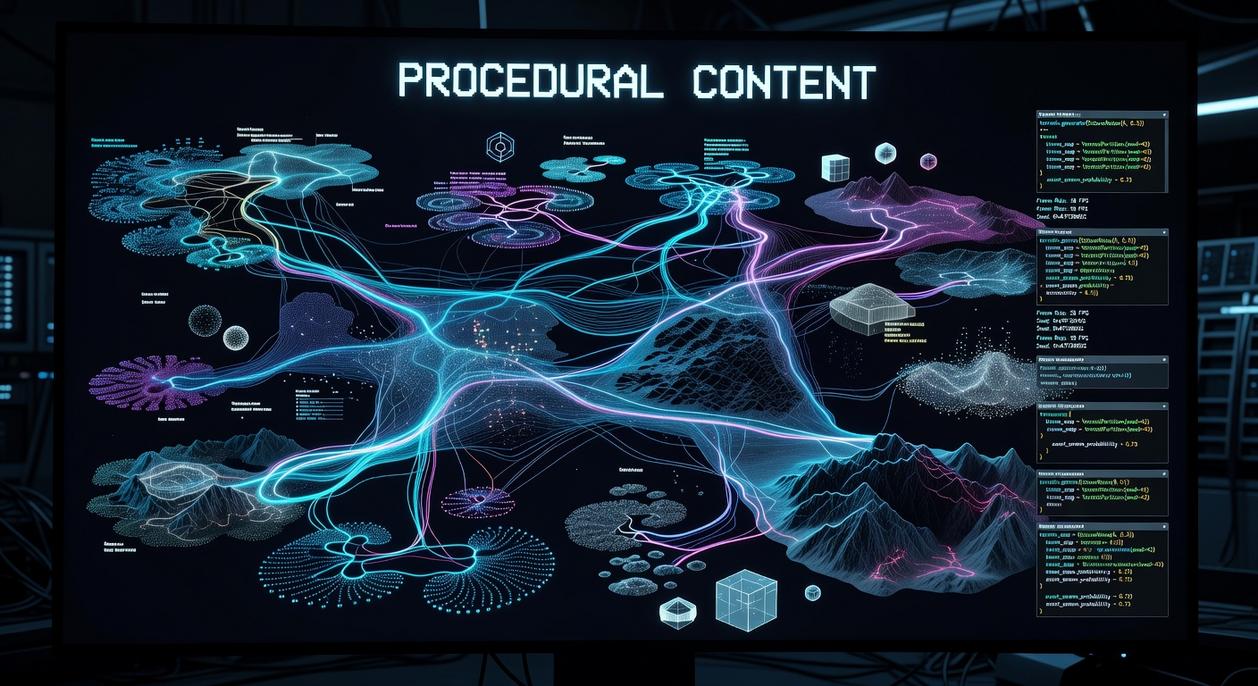
Procedural Content Generation (PCG) refers to rule-based systems that build game assets through predefined algorithms. Think of Minecraft’s terrain seeds or No Man’s Sky’s planetary math: vast, but ultimately predictable. Every mountain exists because a human wrote the rules.
Modern generative AI flips that script. Using machine learning models—GANs (Generative Adversarial Networks, systems where two neural nets compete to refine outputs) for textures and LLMs (Large Language Models, data-trained text predictors) for dialogue—it learns patterns from massive datasets and produces ai generated game content that feels genuinely new.
Here’s the core difference:
PCG executes human rules; Generative AI infers and invents them. I’ve always felt PCG is like a brilliant factory, while AI is closer to a moody artist. Some argue AI is just fancier automation. I disagree; when a model recombines patterns into dialogue no designer explicitly scripted, that’s not scaling—it’s synthesis.
PCG vs Generative AI
| Aspect | PCG | Generative AI |
| Driver | Human rules | Learned patterns |
| Output | Structured variation | Emergent novelty |
This shift changes development philosophy. Studios once used algorithms to stretch assets across galaxies. Now, they collaborate with models to co-create mechanics, quests, even playstyles. In my view, that’s both thrilling and terrifying—and absolutely the future. For developers.
Building Infinite Playgrounds: AI in World & Level Design
Step into a forest that didn’t exist five seconds ago. Mist curls between procedurally grown pines, leaves crunch underfoot, and distant alien wildlife hums like a broken synth. That’s the promise of AI-driven worldbuilding.
1. Dynamic Environments
At the core is seed-based generation—a method where a single numeric “seed” acts like DNA for a world. Change the seed, and mountains shift, rivers bend, cities rearrange themselves. Traditional procedural generation has done this for years, but AI refines it, ensuring terrain, foliage, and architecture feel aesthetically coherent rather than randomly stitched together. Think No Man’s Sky, but with smarter ecosystems and weather that smells of rain before a storm rolls in.
Skeptics argue this risks soulless landscapes. Fair. Early procedural worlds felt hollow. But modern models analyze art direction, biome logic, and player flow to produce ai generated game content that feels authored rather than assembled.
2. Adaptive Level Mechanics
Imagine walls subtly widening when combat gets frantic, or puzzles reconfiguring as you master mechanics. Adaptive level design uses behavioral data—reaction time, path choices, failure rates—to tune layouts in real time. The result? A constant hum of tension, like a drumbeat that never quite resolves.
Critics worry about fairness. If levels shift, is victory earned? Developers counter that dynamic scaling preserves challenge, much like a good dungeon master adjusting encounters mid-session.
3. Quest & Objective Generation
Beyond fetch quests, AI can craft multi-part objectives tied to world states. If a bridge collapses in a storm, rebuilding it might unlock trade routes and new factions. Replayability spikes because outcomes ripple logically.
Pro tip: Track player-driven world states to keep emergent narratives consistent.
For a broader look at where this tech is heading, explore the biggest gaming trends shaping 2026.
Breathing Life into Pixels: AI-Driven Characters and Stories
NPCs That Remember
Imagine walking back into a village after accidentally burning down a wheat field. The blacksmith squints and says, “You again? Last time you were here, my cousin lost his crops.” That’s persistent memory—an AI system that stores and recalls prior player actions. In game design, persistent memory means data that survives beyond a single interaction, allowing non-player characters (NPCs) to adapt over time.
Critics argue this is overkill. “Players won’t notice,” one veteran designer claimed at GDC. But players do notice. When characters react believably, immersion deepens (and yes, guilt hits harder). Continuity creates consequence.
Generative Dialogue Systems
Traditional dialogue trees branch like a choose-your-own-adventure book. Large Language Models (LLMs)—AI systems trained on massive text datasets—replace those rigid paths with fluid conversation. “It felt like I was talking to a real person,” a beta tester said after trying an LLM-driven RPG.
Skeptics warn about unpredictability. Fair. Unscripted dialogue can wander. But guardrails and fine-tuning mitigate risks (Pro tip: constrain tone and lore rules in system prompts).
| Feature | Static Dialogue Trees | LLM-Driven Dialogue |
|———-|———————-|———————|
| Flexibility | Limited branches | Open-ended |
| Replay Value | Predictable | Dynamic |
| Immersion | Scripted | Conversational |
Emergent Narratives
When memory-rich NPCs meet dynamic quests, stories emerge. Emergent narrative refers to plotlines formed organically through player interaction rather than prewritten scripts. One developer described it simply: “We stopped writing every scene. We built systems—and let players surprise us.”
This is ai generated game content reshaping agency. Like a great tabletop session, no two playthroughs unfold the same. Some say authored stories are stronger. Sometimes they are. But reactive systems trade control for possibility—and that trade can feel magical.
Game development has ballooned in scale. Worlds are bigger, systems deeper, player expectations sky-high. The solution many teams now embrace is ai generated game content: tools that build landscapes, quests, dialogue, even balance passes at machine speed. Properly used, it empowers small studios to punch above their weight and lets AAA teams iterate without burnout.
However, I learned the hard way that scale without oversight backfires. On one project, we let procedural tools flood our world with filler missions. Players noticed. The map felt like copy and paste fantasy (think endless fetch quests from a parody RPG). The mistake wasn’t the tech; it was our lack of guardrails. So we built review pipelines, narrative style guides, and human sign-offs. Quality control matters.
At the same time, critics argue AI risks soulless design and creative job loss. Those concerns deserve space. Ethical sourcing, credits and thoughtful integration are nonnegotiable.
Looking ahead, the frontier isn’t replacement but augmentation. Designers steer the systems; algorithms expand the canvas. The result? Games that react to your playstyle, remix challenges, and stay surprising long after launch.
So pay attention to how new titles describe their world-building tech. That’s where the next leap in play begins.
Level Up Your Play and Stay Ahead
You came here to sharpen your understanding of today’s gaming landscape — from evolving core mechanics and competitive playstyles to the tech and gear shaping performance. Now you’ve got the clarity to adapt, compete smarter, and stay ahead of the curve.
The real pain point isn’t lack of passion — it’s falling behind. Games evolve fast. Esports metas shift overnight. Engine updates and gear innovations can instantly change what “optimal” looks like. If you’re not actively learning, you’re losing ground.
That’s why staying plugged into expert breakdowns, mechanic deep-dives, and tech-driven insights matters. The right knowledge turns frustration into precision and casual play into calculated dominance.
Ready to step up? Dive into our latest guides, explore advanced breakdowns, and upgrade your setup with proven, performance-focused recommendations. Join thousands of competitive players who rely on us for cutting-edge gaming insights — and start playing smarter today.
 Founder & CEO
Ask Koralia Tornhanna how they got into mag-based game engine explorations and you'll probably get a longer answer than you expected. The short version: Koralia started doing it, got genuinely hooked, and at some point realized they had accumulated enough hard-won knowledge that it would be a waste not to share it. So they started writing.
What makes Koralia worth reading is that they skips the obvious stuff. Nobody needs another surface-level take on Mag-Based Game Engine Explorations, Hot Topics in Gaming, Core Mechanics and Playstyles. What readers actually want is the nuance — the part that only becomes clear after you've made a few mistakes and figured out why. That's the territory Koralia operates in. The writing is direct, occasionally blunt, and always built around what's actually true rather than what sounds good in an article. They has little patience for filler, which means they's pieces tend to be denser with real information than the average post on the same subject.
Koralia doesn't write to impress anyone. They writes because they has things to say that they genuinely thinks people should hear. That motivation — basic as it sounds — produces something noticeably different from content written for clicks or word count. Readers pick up on it. The comments on Koralia's work tend to reflect that.
Founder & CEO
Ask Koralia Tornhanna how they got into mag-based game engine explorations and you'll probably get a longer answer than you expected. The short version: Koralia started doing it, got genuinely hooked, and at some point realized they had accumulated enough hard-won knowledge that it would be a waste not to share it. So they started writing.
What makes Koralia worth reading is that they skips the obvious stuff. Nobody needs another surface-level take on Mag-Based Game Engine Explorations, Hot Topics in Gaming, Core Mechanics and Playstyles. What readers actually want is the nuance — the part that only becomes clear after you've made a few mistakes and figured out why. That's the territory Koralia operates in. The writing is direct, occasionally blunt, and always built around what's actually true rather than what sounds good in an article. They has little patience for filler, which means they's pieces tend to be denser with real information than the average post on the same subject.
Koralia doesn't write to impress anyone. They writes because they has things to say that they genuinely thinks people should hear. That motivation — basic as it sounds — produces something noticeably different from content written for clicks or word count. Readers pick up on it. The comments on Koralia's work tend to reflect that.