
Want to know how competitive gaming events actually work? This guide’s got you covered. Whether you’re a player hunting for your shot, a fan wanting the real breakdown, or just curious about the scene, you’ll find what you need here. We’re breaking down esports tournament structure without the jargon, keeping it practical, keeping it straight. No fluff.
Brackets confuse a lot of players. Seeding, qualifiers, playoff systems, it’s hard to know what’s happening, let alone how to actually compete in one. You can’t strategize if you don’t understand the tournament structure underneath it all. This article breaks down the most common formats you’ll run into, shows how they shape gameplay strategy in real time, and explores why certain structures stick around in some games but vanish from others.
We’ve analyzed competitive circuits, game mechanics, and tournament systems across major titles by actually digging into the data ourselves. The real work? Understanding how structure shapes everything, playstyles, team prep, the gap between winners and the rest over time. That’s where patterns emerge. Once you see it, you can’t unsee how design decides the outcome.
By the end, you’ll know exactly how tournaments are built, and how to navigate them with confidence.
Choosing the right format is everything. The wrong setup drains momentum; the right one builds storylines fans remember. Yes, even those reverse sweeps. Start by defining your goals, competitive integrity, broadcast length, community inclusion. Pick one. Then match it to a proven esports tournament structure that fits your player pool and schedule.
Ask yourself:
- How many teams can realistically compete?
- Do you need double elimination for fairness?
- Will group stages create MORE meaningful matches?
Run a test bracket first. You’ll spot scheduling gaps, fatigue risks, and tiebreaker confusion way faster on paper than you will when it all goes live on stream. Fix those problems before the cameras roll.
The core decision: single vs. Double elimination brackets
Understanding the structure of esports tournaments worldwide can enhance your appreciation of competitive gaming, especially when you check out the latest developments in the field in our article, “Pboxcomputers Gaming Updates From Plugboxlinux.
The most fundamental choice you’ll make is how players get eliminated. That single decision shapes the schedule, the crowd’s energy, the whole emotional arc of your event. Format isn’t just logistics. It’s storytelling.
Single Elimination
- How it works: Win and advance. Lose and you’re out. No safety net.
- The tension hits right away. You can almost hear the audience holding its breath before match point. It’s clean, fast, easy to follow, which means even the friend who wandered in for the snacks figures out what’s happening without needing context. No confusion. Just pure competitive energy from the opening bell.
- Cons: One mistimed ability, one shaky start, and a favorite’s done for. It’s brutal. Variance, those random factors that swing outcomes, can completely overshadow skill, and critics aren’t wrong to call that unfair.
- Best for: Open qualifiers, casual events, or games with short, explosive match times.
Some purists insist this is the only “true” competitive format because pressure reveals greatness. But does one bad round really define a champion?
Double Elimination
- How it works: Lose once, drop to the lower bracket. Lose twice, you’re out.
- Pros: It feels fairer. The lower bracket run—controllers clicking furiously, casters nearly shouting—is the stuff of legend. Consistency is rewarded.
- Cons: It takes more time, more stamina, and more explanation for viewers.
- Best for: Main events, pro circuits, and high-variance titles.
Pro tip: If you expect unpredictable outcomes, double elimination protects competitive integrity while preserving hype.
Building momentum: group stages and round-robin play
Longer events usually start with a group stage to build momentum before moving into knockout rounds. It forces a reckoning. Teams have to prove they’re actually consistent, not just lucky, before they get a real shot at the trophy. That’s the whole point.
“Group stages separate contenders from pretenders,” one tournament admin told me. “Anyone can pop off once.” They paused. “We want to see who shows up every match.”
Round-Robin
Round-robin means every team in a group plays every other team once. Standings are based on win-loss records.
- Pros: Competitive integrity stays high when everyone faces the same opponents. You get more matches, more data, more screen time for fans. Yes, more chances for that reverse sweep.
- Cons: It’s time-consuming. A 10-team group requires 45 matches. That’s a marathon, not a sprint.
- Best for: Premier leagues and world championships with broadcast windows to fill.
Critics say round-robin kills the hype, there’s no sudden-death tension, no last-second drama. A caster made that exact point on stream once. Valid argument. But here’s the thing: accuracy matters more. FIFA World Cup groups and League of Legends Worlds both stick with round-robin variations because fairness builds legitimacy. That’s not opinion, it’s in the rulebooks (FIFA Tournament Regulations; Riot Games Esports Rulebook).
Swiss System
The Swiss System pairs competitors each round with others holding the same record. No one is eliminated early.
- Pros: Handles massive player pools efficiently. Ideal for card games and open LANs.
- Cons: The final standings can feel clinical—no dramatic last stand.
- Best for: Trading card circuits and large qualifiers.
As one Magic: The Gathering pro put it, “Swiss rewards consistency, not luck.” If you’re curious how formats evolved to balance drama and fairness, explore the evolution of competitive gaming leagues.
Combining formats for maximum impact
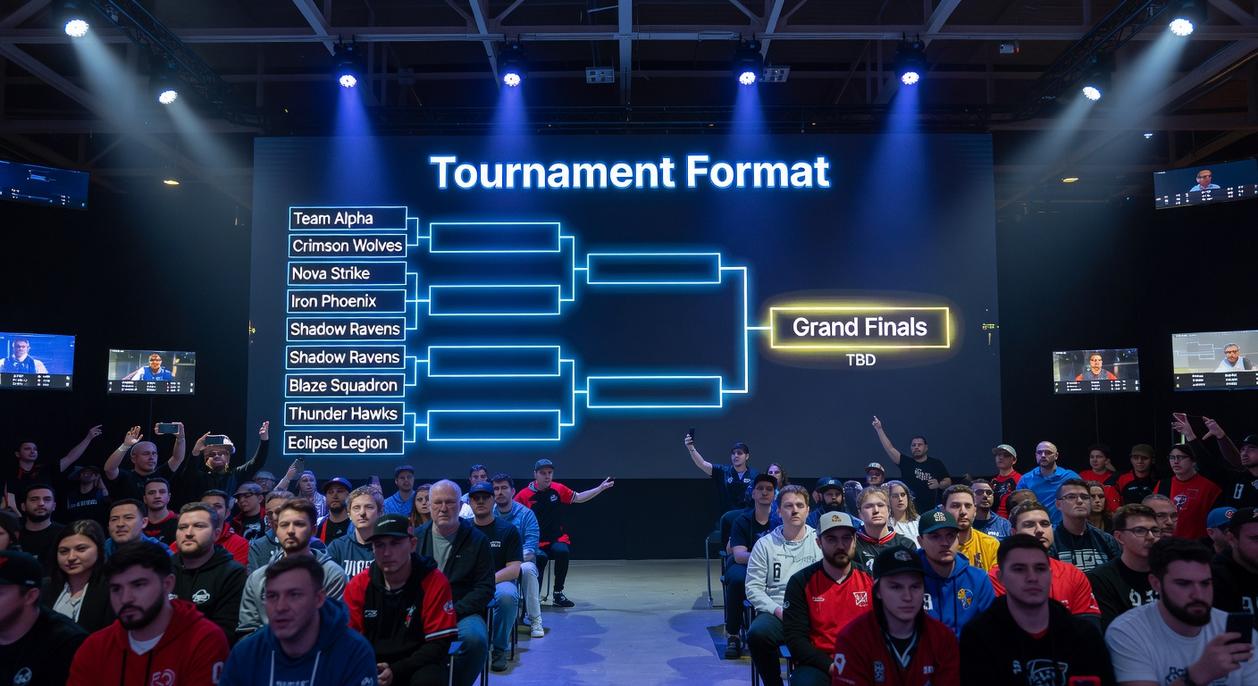
The world’s best tournaments don’t stick to one system. They mix formats, balancing fairness, spectacle, and player stamina in ways a single structure can’t touch. Here’s the reality: esports tournament design thrives on hybrid approaches. A pure round-robin gets boring. Double elimination gets messy. But blend them? You get credibility without sacrificing the chaos that makes people watch.
The Classic Hybrid Model starts broad, then narrows dramatically:
- Group Stage (Round-Robin or Swiss): Everyone plays multiple matches, reducing fluke eliminations.
- Playoffs (Single or Double Elimination): The top contenders clash in high-stakes brackets where every decision matters.
Look, there’s real debate about which opening stage works best. Swiss formats reward consistency, round-robin guarantees everyone plays everyone, but both have gaps. Upsets still happen. Ask any top seed that’s lost to a wildcard, they’ll tell you the bracket matters less than you’d think.
Match structure also shapes outcomes:
- Best-of-1 (Bo1): Fast, volatile, and upset-prone.
- Best-of-3 (Bo3): A balanced test of adaptation.
- Best-of-5 (Bo5): A marathon demanding depth and endurance.
Some argue longer series always prove the “better” team wins. Maybe. But fatigue, momentum swings, and drafting mind games complicate that assumption.
It’s a smart move, seeding ranking teams before placement to prevent powerhouse clashes too early in the tournament. When the seeding criteria are transparent, competitors trust the system before the first match even starts. That matters. Most organizers don’t realize how much credibility hinges on whether people actually understand the bracket rules upfront.
Matching the format to your game and goals
You’ve seen the options—now it’s decision time. Choosing a format isn’t just about filling a schedule; it’s about aligning your game design, logistics, and audience expectations. Think of it as picking a ruleset that shapes the entire story arc (yes, like choosing between a Marvel origin film or a full Avengers ensemble).
Here’s the side-by-side breakdown:
- Your Game: Swiss vs. Double Elimination Fast, high-RNG games, digital card battlers especially, do better in Swiss. You play multiple rounds. Variance evens out naturally. Slower, strategy-heavy titles like MOBAs and tactical shooters? Double Elimination works there because you get a second chance and competitive integrity stays intact. Single Elimination keeps stakes higher, sure, but a single bad matchup shouldn’t wipe out everything you’ve prepared for. It’s a coin flip that costs you the whole tournament.
- Your Logistics: Ambition vs. Reality Round-Robin into Double Elimination sounds epic. But limited setups and a one-day venue window? That’s a scheduling nightmare you probably can’t pull off. The math doesn’t work. You’d need more stations, more referees, more tables, and you’ve got one day to run it all. Be realistic about time, staffing, and hardware. What actually fits in your window? Start there, then build backward.
-
Your Audience: Hardcore vs. Casual
Veterans value layered brackets. Casual viewers prefer clarity. A clean bracket is easier to follow (and easier to broadcast).
Pro tip: Map your esports tournament structure backward from your finals time slot to avoid overruns.
Level up your competitive edge
You came here to understand competitive gaming ecosystems. How they work. What makes them tick. Now you can see it firsthand: formats shape outcomes. Brackets determine matchups. Seeding matters, and so do progression systems. They’re not abstract concepts floating around in theory, they directly affect how teams perform, how viewers engage, whether the scene grows or tanks entirely. Master the tournament structure, and you’ve got a real strategic edge that most competitors don’t even think about.
If you’ve ever felt overwhelmed by shifting formats, unclear pathways to finals, or inconsistent competitive results, that frustration’s valid. Without a clear grasp of structure, even the most skilled players and teams struggle to adapt. They can’t anticipate what’s coming. They can’t plan accordingly.
The solution’s straightforward: study structure as seriously as you practice mechanics. Before competing, break down tournament formats. Map pools, elimination rules, bracket resets. They all shift pacing and momentum in ways that matter. That’s where preparation actually pays off. It’s the difference between walking in blind and knowing what you’re up against. Control what you can control.
Want to actually win your bracket? Competitive breakdowns and meta analyses show what’s working right now. Everyone else? They’re missing the patterns that drive real wins. Thousands of competitive players are already using these strategies. Start refining your approach today, and you’ll feel the difference.
 Creative Director
There is a specific skill involved in explaining something clearly — one that is completely separate from actually knowing the subject. Lorraines Pricevadan has both. They has spent years working with expert insights in a hands-on capacity, and an equal amount of time figuring out how to translate that experience into writing that people with different backgrounds can actually absorb and use.
Lorraines tends to approach complex subjects — Expert Insights, Core Mechanics and Playstyles, Tech-Driven Gaming Gear Tips being good examples — by starting with what the reader already knows, then building outward from there rather than dropping them in the deep end. It sounds like a small thing. In practice it makes a significant difference in whether someone finishes the article or abandons it halfway through. They is also good at knowing when to stop — a surprisingly underrated skill. Some writers bury useful information under so many caveats and qualifications that the point disappears. Lorraines knows where the point is and gets there without too many detours.
The practical effect of all this is that people who read Lorraines's work tend to come away actually capable of doing something with it. Not just vaguely informed — actually capable. For a writer working in expert insights, that is probably the best possible outcome, and it's the standard Lorraines holds they's own work to.
Creative Director
There is a specific skill involved in explaining something clearly — one that is completely separate from actually knowing the subject. Lorraines Pricevadan has both. They has spent years working with expert insights in a hands-on capacity, and an equal amount of time figuring out how to translate that experience into writing that people with different backgrounds can actually absorb and use.
Lorraines tends to approach complex subjects — Expert Insights, Core Mechanics and Playstyles, Tech-Driven Gaming Gear Tips being good examples — by starting with what the reader already knows, then building outward from there rather than dropping them in the deep end. It sounds like a small thing. In practice it makes a significant difference in whether someone finishes the article or abandons it halfway through. They is also good at knowing when to stop — a surprisingly underrated skill. Some writers bury useful information under so many caveats and qualifications that the point disappears. Lorraines knows where the point is and gets there without too many detours.
The practical effect of all this is that people who read Lorraines's work tend to come away actually capable of doing something with it. Not just vaguely informed — actually capable. For a writer working in expert insights, that is probably the best possible outcome, and it's the standard Lorraines holds they's own work to.