

The idea of a silent, fuel-less magnetic engine that powers itself indefinitely has fascinated inventors for generations. Viral demonstrations and bold claims make it seem as though perpetual motion is just one breakthrough away. But despite the excitement, a truly self-running magnetic engine remains beyond reach. Why? In this article, we unpack the physics that make perpetual motion impossible, from the laws of thermodynamics to magnetic field limitations and real-world engineering constraints. By examining the hard science behind mag engine development challenges, we’ll clearly explain why these devices fail—and what obstacles continue to stand in the way.
Confronting the laws of physics: the energy conservation barrier
As teams navigate the common development challenges in MAG engine projects, they often find valuable insights in external resources, such as the innovative strategies discussed in our article on Hacks Zeromaggaming.
First, let’s define the big rule: The First Law of Thermodynamics states that energy cannot be created or destroyed, only transformed from one form to another (U.S. Department of Energy). Anyone claiming a magnetic engine produces continuous work with no input? They’re describing a machine that creates energy from nothing. That violates physics. Full stop.
Test it yourself. Push two magnets together and you’ll feel the resistance. That’s potential energy, stored just by position. A magnetic field is conservative, which means any energy you gain moving through it has to come back out when you return to where you started (HyperPhysics, Georgia State University). So there’s no net gain. None.
Think of it like a ball on a hill. Roll it down, and you get energy. But then what? You’ve got to push it back up, and that costs you at least as much as you gained. A magnetic field works the same way, it’s just a landscape of invisible hills and valleys. There’s no secret shortcut here. If there were, power companies would’ve figured it out already.
Now consider Earnshaw’s Theorem. It’s a mathematical proof showing that stable, static equilibrium using only magnetic forces is impossible. In other words, you can’t levitate a magnetic object in midair using fixed magnets alone, no matter how you arrange them. This is why so many perpetual-motion sketches fall apart under scrutiny.
Pro tip: when you’re looking at bold claims about mag engine development, ask yourself a simple question. Where’s the energy actually coming from? If nobody can answer that clearly, you don’t have output either, just hype. It’s that straightforward.
For deeper system design context, explore getting started with mag based game engine architecture.
Beyond theory: the practical hurdles of magnetic drag and friction
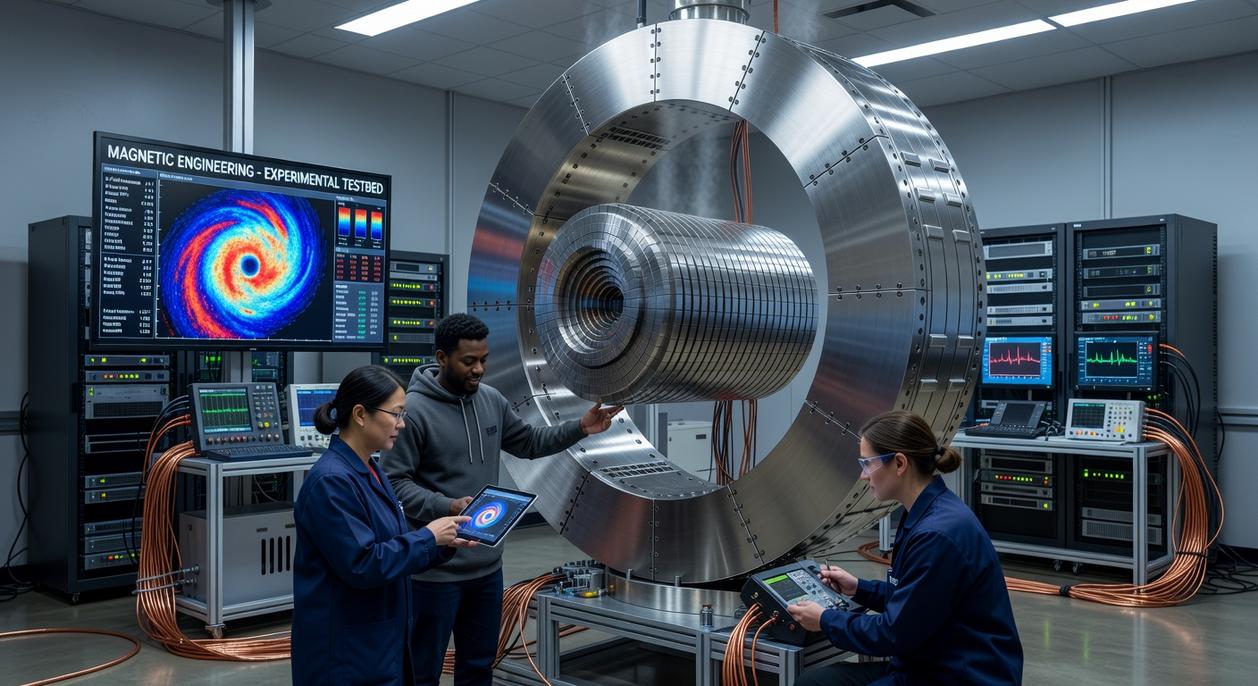
First, let’s tackle Lenz’s Law. It’s the rule that says an induced current will oppose the change that created it. When a magnet moves past a conductive material, something interesting happens: swirling electrical loops form. We call them Eddy currents. Those currents create their own magnetic field, pushing back like an invisible brake. It’s why a magnet falls slowly through a copper tube. Physics demos love this one, and honestly, it feels like sci-fi when you see it in person.
Building rotating hardware? Skip solid metal blocks. Laminated cores do the heavy lifting instead, slicing through eddy current loops and cutting heat loss with thin, insulated layers that actually work. The U.S. DOE confirms it: laminations significantly reduce core losses in motors, so you’re looking at real efficiency gains without the headache.
Next, cogging torque. That jerky “snap” you feel when rotor magnets lock onto stator teeth, it’s everywhere in permanent magnet motors and it drains energy fighting those aligned positions. Some say it barely matters in small systems. But even tiny amounts wreck precision builds. Skewing the stator slots or tweaking magnet spacing fixes it. Everything spins smooth after. You can’t ignore it in tight tolerances, and the fix itself is straightforward.
Finally, there’s hysteresis loss, energy dissipates as heat when magnetic materials get magnetized and demagnetized over and over. Bend a paperclip back and forth and you’ll feel it warming up. That’s hysteresis in action. Each cycle burns energy, and it adds up fast. Silicon steel and similar low-hysteresis materials keep this drain minimal, which is why they’re the go-to choice for anything that cycles power repeatedly, transformers, motors, inductors, anything that can’t afford to waste heat.
These effects often surface in mag engine development challenges, where theory meets stubborn physical limits (yes, even Tony Stark would need better laminations).
The material question: durability, cost, and the limits of magnets
First, let’s clear up something: permanent magnets aren’t actually permanent. They lose their magnetic strength over time, it’s called demagnetization, and it happens when materials get too hot, take repeated physical hits, or encounter strong opposing magnetic fields. There’s even a specific temperature, the Curie point, where the magnetic order just collapses entirely. The fact that this happens at all makes those “forever power” claims sound way more like sci-fi than actual science. Sorry, Tony Stark.
Power costs aren’t trivial, either. Neodymium and samarium-cobalt, those high-strength rare-earth magnets, depend on byzantine global supply chains and mining markets that swing wildly. Price volatility’s real. The U.S. Geological Survey confirms rare-earth supply clusters geographically, creating serious geopolitical exposure. You’re looking at astronomical costs to engineer a powerful motor around these materials, and that’s before scaling. Scale it up? The economics don’t work.
Then there’s brittleness. These magnets are ceramic-like, hard but fragile. They chip, crack, resist machining under stress. Serious mag engine development challenges emerge when you’re designing systems that vibrate, spin, or heat up.
Some argue material science will solve all this. Maybe. But right now, durability limits, high costs, and manufacturing headaches make me skeptical that magnets alone are the shortcut people hope for. The promise is always there, new alloys, better compounds, breakthroughs just around the corner. Yet the gap between lab results and what actually ships is brutal. Most materials that work in controlled conditions fall apart under real-world stress. The money required to scale production is staggering. And even when you’ve got a material that checks every box, you’ve still got to figure out how to make it at volume without destroying your margins. That’s where the dream crashes into reality.
The stability paradox
The “magnetic motor” dream crashes into Earnshaw’s Theorem, a physics principle stating you can’t get stable levitation or endless motion from static magnetic fields alone. Magnets seek equilibrium. They find a balance point where attraction and repulsion cancel each other out, and that’s it, motion stops. It’s like a marble rolling to the bottom of a bowl and staying put, except there’s no escape, no exception, no clever workaround that lets you cheat the math.
Some argue clever geometry can bypass this. Even in mag engine development, though, redesigned arrays still get stuck. The system finds a new balance point. Physics doesn’t blink.
Then there’s magnetic “shielding.” Real shields don’t block fields, they redirect them. And that’s where things get messy. Redirected fields often create new drag or attraction zones. You’re just trading one stall point for another.
- If continuous rotation were possible without input, we’d see it powering cities already.
So what’s next? You add external energy. Electricity driving electromagnets. But that turns it into a standard electric motor, not something that sustains itself, and here’s the catch: keep the motion going, and you’re feeding it power the whole time. No free lunch.
From impossible engines to real-world innovations
The dream of magnetic engines hit a wall. Physics doesn’t bend, energy bleeds away through drag and hysteresis, and materials crack under pressure. But failure’s a funny thing, it forced us to actually understand magnetism, which unlocked discoveries in materials science we’d never have stumbled into otherwise. Each barrier we crashed into made us smarter about what’s possible.
That pivot led to today’s ultra-efficient brushless DC motors, smart systems that pair permanent magnets with precisely controlled electromagnets. They’re everywhere now. PC cooling fans. Hard drives. Even the haptic feedback inside premium gaming controllers. What seemed impossible a few decades ago? It’s just everyday innovation now.
 Founder & CEO
Ask Koralia Tornhanna how they got into mag-based game engine explorations and you'll probably get a longer answer than you expected. The short version: Koralia started doing it, got genuinely hooked, and at some point realized they had accumulated enough hard-won knowledge that it would be a waste not to share it. So they started writing.
What makes Koralia worth reading is that they skips the obvious stuff. Nobody needs another surface-level take on Mag-Based Game Engine Explorations, Hot Topics in Gaming, Core Mechanics and Playstyles. What readers actually want is the nuance — the part that only becomes clear after you've made a few mistakes and figured out why. That's the territory Koralia operates in. The writing is direct, occasionally blunt, and always built around what's actually true rather than what sounds good in an article. They has little patience for filler, which means they's pieces tend to be denser with real information than the average post on the same subject.
Koralia doesn't write to impress anyone. They writes because they has things to say that they genuinely thinks people should hear. That motivation — basic as it sounds — produces something noticeably different from content written for clicks or word count. Readers pick up on it. The comments on Koralia's work tend to reflect that.
Founder & CEO
Ask Koralia Tornhanna how they got into mag-based game engine explorations and you'll probably get a longer answer than you expected. The short version: Koralia started doing it, got genuinely hooked, and at some point realized they had accumulated enough hard-won knowledge that it would be a waste not to share it. So they started writing.
What makes Koralia worth reading is that they skips the obvious stuff. Nobody needs another surface-level take on Mag-Based Game Engine Explorations, Hot Topics in Gaming, Core Mechanics and Playstyles. What readers actually want is the nuance — the part that only becomes clear after you've made a few mistakes and figured out why. That's the territory Koralia operates in. The writing is direct, occasionally blunt, and always built around what's actually true rather than what sounds good in an article. They has little patience for filler, which means they's pieces tend to be denser with real information than the average post on the same subject.
Koralia doesn't write to impress anyone. They writes because they has things to say that they genuinely thinks people should hear. That motivation — basic as it sounds — produces something noticeably different from content written for clicks or word count. Readers pick up on it. The comments on Koralia's work tend to reflect that.